Saturday, 11 April 2020

Image render of 8-inch Huawei MatePad T appears online

Following the launch of the flagship MatePad Pro 5G, it seems that Huawei will soon introduce a more compact and affordable option, the MatePad T (KOB2-W09).
Image render of 8-inch Huawei MatePad T appears online
Huawei MatePad T

The budget MatePad is coming?

Reliable leaker Evan Blass @evleaks shared on Twitter images of the said upcoming tablet. It shared that it'll be a compact 8-inch tablet.

Unlike the flagship MatePad Pro, it has thick top and bottom bezels. On the top bezel, you'll see that it has a single selfie camera. The top and bottom bezels are not that clear, but I won't be surprised if it has a pair of speakers there like other Huawei mid-range tablets with stereo speakers.

At right, you'll see that it has a power button and the volume keys. At the back, there's a single camera.
KOB2-W09
KOB2-W09

WiFi alliance revealed that it'll come with dual-band WiFi and EMUI 10 based on Android 10 out of the box.

Other than that, there are no details regarding its specifications. Most likely, it'll come with lower-end specs compared to the Kirin 990 or 990 5G-powered MatePad Pro and MatePad Pro 5G.

What do you guys think? Could this be the next good affordable Huawei tablet?


from GIZGUIDE | Your Gadget Coach https://ift.tt/2UXHuvT

What is PDAF and how does it work? Phase Detection Autofocus explained

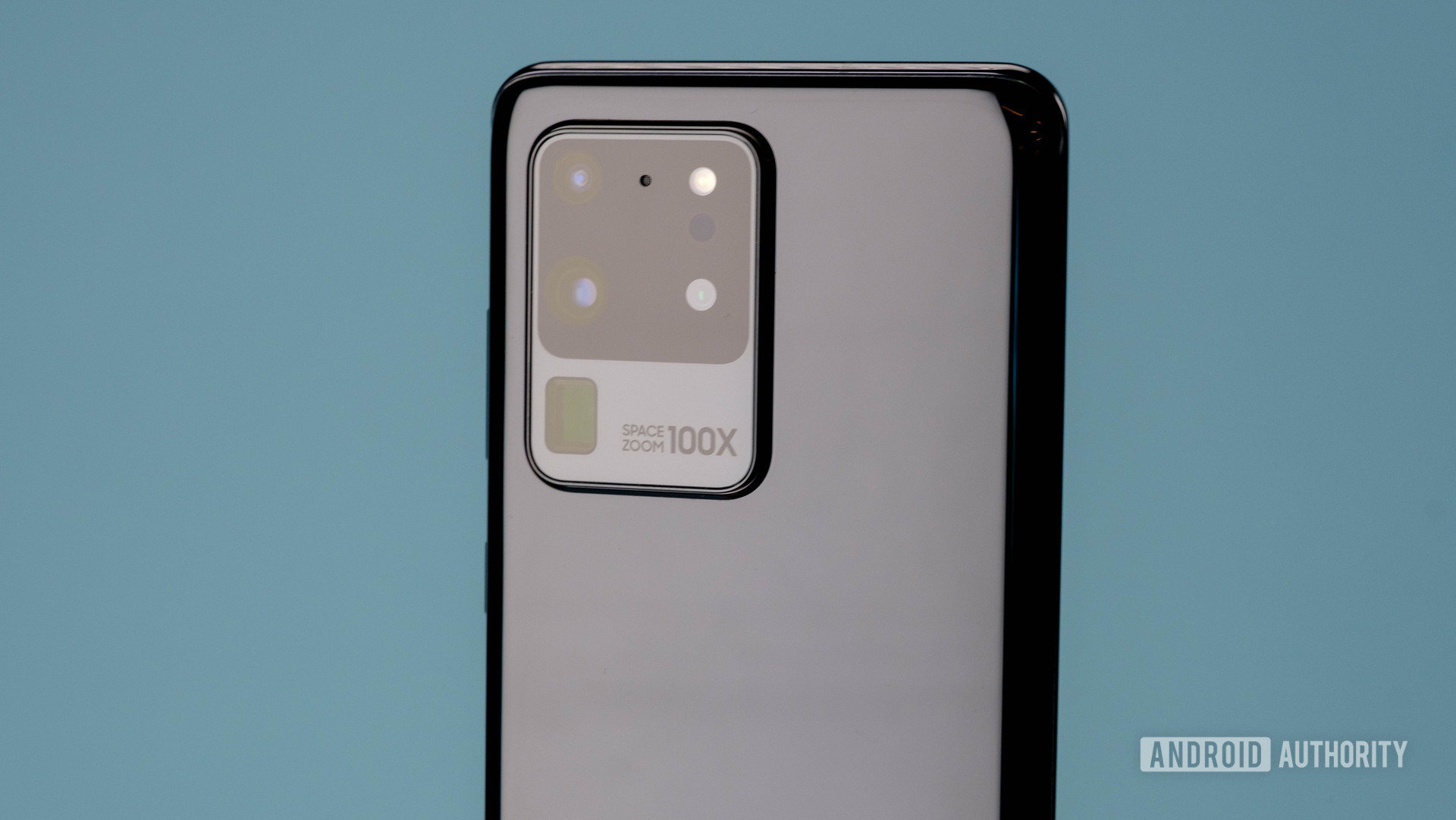
Samsung Galaxy S20 Ultra vs Apple iPhone Pro Max - PDAF explained

Autofocus technology is one of the key pillars of mobile photography, ensuring crisp clean captures of even the fastest moving subjects. But did you know that autofocusing comes in a variety of types, depending on the sensor inside your smartphone or camera? Today we’re going to dive into Phase Detection autofocus (PDAF), one of the most common types of autofocus.

Phase detection autofocus is found in a lot of modern smartphone cameras. It’s both faster and more accurate than classic contrast detection. Contrast detection is the simplest and cheapest form of autofocus, but also the slowest and least accurate with moving subjects. So what makes PDAF so much better?

What is PDAF and how does it work?

Like all good camera technologies, PDAF traces its roots back to the DSLR. DSLR cameras use mirrors to reflect copies of the main sensor’s light at a dedicated phase detection sensor. Smartphones don’t have the same space luxury to fit all these parts in. Instead, mobile sensors have dedicated PDAF pixels built into the image sensor, an approach borrowed from compact cameras.

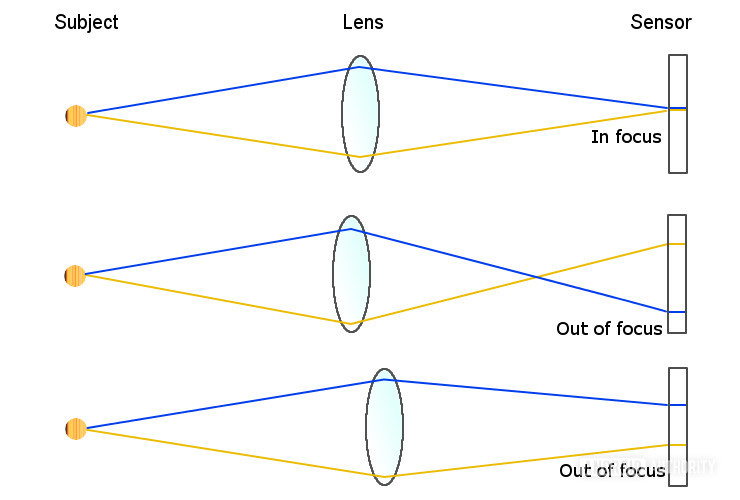
The simplest way to understand how PDAF works is to start by thinking about light passing the camera lens at the very extreme edges. When in perfect focus, light from even these extremes of the lens will refract back to meet at an exact point on the camera sensor. A blurry image is a result of this focus/meeting point being set either in front of or behind the image sensor. Adjusting the lens to change this focal point is exactly how camera focusing works.

Camera Lens Focusing - PDAF explained

In other words, we can tell if an image is in focus because even light coming from two different points on the lens converge on a single point. DSLR phase detection autofocus cameras use two dedicated PDAF sensors to capture separate images for comparison. Compact cameras and smartphones don’t have this luxury. Instead, this dual perspective has to be created using dedicated phase detecting photodiodes on the image sensor to itself.

Related: Compact camera vs smartphone shootout

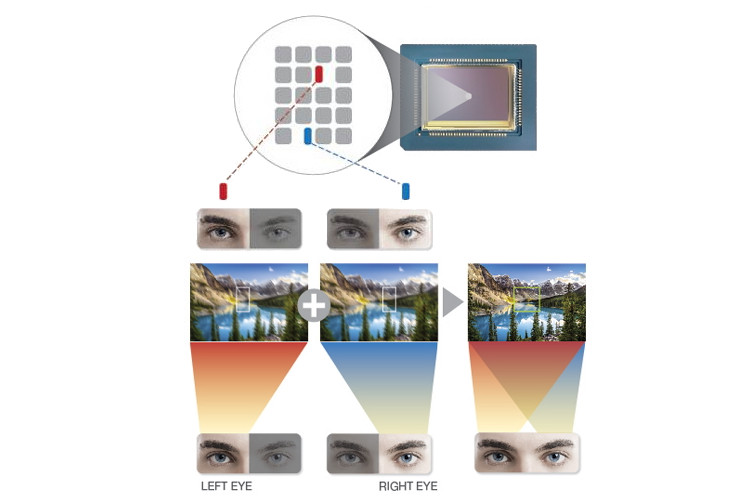
These photodiodes are physically masked such that light from only one side of the lens reaches it. This produces left-looking and right-looking pixels on a single image sensor, giving us our two images with which to compare focus. The phase difference between the two images is calculated to determine the focus point. Samsung’s diagram below offers an intuitive look at this by comparing these left/right pixels to our eyes.

Samsung explains phase detection autofocus PDAF

Samsung By obtaining left and right offset images, PDAF works a little like the human eye.

If the image is out of focus, the phase difference data between images is used to calculate how far the lens needs to be moved to bring it into focus. This is what makes PDAF focusing so fast compared to contrast detection. However, with half of the pixel blocked, these photodiodes end up with less light than a regular pixel. This can cause issues with focusing in low light, where traditional contrast detection is still often used as a hybrid solution.

As you can also see, we don’t need to use every pixel on the camera to figure out the focus. Instead, several pixel strips across the sensor will do. Typically only 5 to 10% of sensor pixels are reserved for autofocusing. However, vertical strips mean that cameras can have problems focusing on horizontal lines, so better sensors use cross focus patterns.

PDAF pros and cons

Huawei P40 Pro and P30 Pro comparison rear camera modules - PDAF explained

Compared to traditional contrast autofocus, phase detection auto focus is faster and usually more accurate. Contrast autofocus takes a long time because it has to scan through potentially its entire range of focal points to find the sharpest focus. It’s essentially trial and error. With PDAF, the phase difference is used to almost immediately calculate how far the lens needs to be moved to achieve focus.

Less than 10% of sensor pixels are dedicated to phase detection autofocus.

However, on-sensor PDAF has a few drawbacks compared to DSLR PDAF. The nature of small smartphone sensors and even smaller pixels makes noise an issue, which is problematic in low light situations. Even phase detection autofocus can take several attempts to obtain perfect focus in less than ideal conditions. Although using more pairs of detectors helps speed things up. As a result, smartphones sometimes implement a hybrid approach to tackle this shortcoming.

Phase Detection autofocus is a must-have for the serious mobile photographer. Fortunately, you’ll find this technology in all high-end and even most mid-range smartphones launched in the past few years. In fact, high-end smartphone cameras now include much improved Dual Pixel autofocus. Stay tuned for a deeper dive into that very soon.

More posts about smartphone cameras


from Android Authority https://ift.tt/3a4BlSN

Real working Jailbreak für 12.4.6?

Hey im looking for working jailbreak for my oder 12.4.6 devices. everything i found is behind paywalls and looks like ripoff. dont geht me wrong: i am actually willing to pay as long as its real and working. any suggestions? Please

from iOSGods RSS Feed https://ift.tt/34qV5iB

Why we are hardwired to focus on the wrong parts of our product


Did you know TNW Conference has a track fully dedicated to exploring new design trends this year? Check out the full ‘Sprint’ program here. In his book Thinking, Fast and Slow, Noble Prize-winning economist Daniel Kahneman discusses the psychological phenomenon of loss aversion, which he, along with Amos Tversky, first identified back in 1979. At its core, loss aversion refers to the tendency of the human brain to react more strongly to losses than it does to gains. Or, as Wikipedia puts it, people “prefer avoiding losses to acquiring equivalent gains: it is better to not lose $5 than to…

This story continues at The Next Web


from The Next Web https://ift.tt/2UYn9GM

Friday, 10 April 2020

Top 5 highlights of Realme 6

Realme 6 could be the brand's next beastly bang-for-the-buck device. Based on its specs, it is a solid upgrade coming from the realme 5.
Realme 6 comet-inspired design

Top 5 highlights of Realme 6

1. 90Hz FHD+ screen - With a fast refresh rate screen becoming a norm, realme 6 joins the party with a 6.5-inch 3D curved display with 2400 x 1080 FHD+ resolution, 90Hz refresh rate, and Gorilla Glass 3 protection.

This refresh rate will help in a smoother experience both in gameplay as well as normal usage.

2. Competitive specs - Realme always tout their devices as one of the most affordable gaming machines.

Realme 6 is no different. It has a 2.05GHz 12nm MediaTek Helio G90T octa-core processor, Mali-G76 3EEMC4 GPU, up to 8GB LPDDR4X RAM, up to 128GB UFS 2.1 expandable storage, and a 4,300mAh battery with 30W Flash Charge.

This is more than enough to run the most popular games and apps smoothly.
Realme 6 camera features

3. 64MP quad-cam - Realme 6 comes with competitive camera specs as well It has a quad-camera setup sporting a 64MP f/1.8 Samsung GW1 w/ EIS + 8MP f/2.3 119-degree ultra-wide-angle + 2MP f/2.4 macro + 2MP f/2.4 mono with LED flash. The variety of sensors it has gives it a well-rounded camera suite for different situations.

4. Feature-packed device - The 30W flash charge alone is a great feature to have on the realme 6. Add the dual-band WiFi, 4G LTE, Bluetooth 5.0, OTG, FM Radio, GPS, GLONASS, fingerprint sensor, face unlock, splash resistance, and Dolby Atmos support then you get a bang-for-the-buck device that can last you while.

5. Expected competitive price - If we follow realme's pricing of its previous series, we can expect that the realme 6 to be priced competitively.

There's a chance that it will be the most affordable device with a 90Hz FHD+ screen once launched.

In India, it has a crazy low starting price of INR 12,999 or around PHP 8.9K out of straight conversion.

Realme 6 Specs

Display: 6.5-inch 3D curved Gorilla Glass 3 protected LCD screen w/ 90Hz refresh rate, FHD+ 2400 x 1080 resolution at 405 ppi
CPU: 2.05GHz 12nm MediaTek Helio G90T octa-core processor
GPU: Mali-G76 3EEMC4
RAM: 4GB/6GB/8GB LPDDR4X
ROM: 64GB/128GB UFS 2.1 expandable via microSD card slot up to 256GB (dedicated)
Back Camera: 64MP f/1.8 Samsung GW1 w/ EIS + 8MP f/2.3 119-degree ultra-wide-angle + 2MP f/2.4 macro + 2MP f/2.4 mono + LED flash
Selfie Camera: 16MP f/2.0
Battery: 4,300mAh w/ 30W Flash Charge
OS: Android 10.0 w/ realme UI 1.0
Connectivity: WiFi 802.11 b/g/n/ac (2.4GHz/5GHz), 4G LTE, Bluetooth 5.0, OTG, FM Radio, GPS, GLONASS, dual SIM
Sensors: Accelerometer, light, orientation, proximity, gyroscope, sound, magnetic
Others: Fingerprint sensor, face unlock, splash resistance, Dolby Atmos, Colors: Comet Blue, Comet White
Dimensions: 162.1 x 74.8 x 9.6 mm
Weight: 191 g
Price: TBC

What do you guys think?


from GIZGUIDE | Your Gadget Coach https://ift.tt/3c4M696