Thursday, 5 November 2020

Philips SmartSleep Wake-Up Light review: Rise and shine

I used to have a really cheap alarm clock. Its discordant ear-piercing shriek became the stuff of early-morning nightmares. Then, one day, it dawned on me that if I really want to rise and shine, I need an alarm clock that – quite literally – helps me get up with the sun.

This is the Philips SmartSleep Wake-Up Light review.

Philips SmartSleep Light: What is it?

Philips SmartSleep Light daylight sunset

Credit: Kris Carlon / Android Authority

In its most basic sense, the Philips Smart Connect Wake-Up Light is an alarm clock that uses light to wake you up gently and naturally. However, it’s much more than just a light therapy tool. Philips really takes the “wellness” angle to the extreme here, with additional features like breathing exercises, nature sounds, environment monitoring, sleep tracking, and more. You can even use it as a bedroom speaker and a phone charger.

Read more: Our guide to home office lighting

What’s good?

Philips SmartSleep Light sunset mode on

rbsh
Credit: Kris Carlon / Android Authority

There’s a lot to like about the Philips SmartSleep Light. From its well-thought-out feature set to its confidence-inspiring claims for improving your sleep quality and overall health, it’s a soothing bedtime panacea.

At night, you can unwind with light- or sound-guided breathing exercises as you prepare for bed. You can then use it as a reading light before activating a relaxing sunset effect when it’s time to drift off.

The Philips SmartSleep Light is a soothing bedtime panacea.

If sound helps you relax, you can be carried off to sleep accompanied by your choice of relaxing soundtracks, including waves lapping at the shore or gentle rain. You can also play your own audio via a 3.5mm auxiliary cable.

Philips SmartSleep Light smartphone connected closeup

Credit: Kris Carlon / Android Authority

If you wake up in the middle of the night, tap the top of the light to activate a soft orange nightlight. It’s just enough to see without waking up your partner or stimulating your senses too much.

In the morning, you will be gently woken with a customizable sunrise effect and the sounds of nature. I loved waking up to gently graduated light rather than a shrieking alarm, especially in the Autumn gloom. Waking up to a slow change in light is far more natural and refreshing. You really feel it throughout your morning.

Philips SmartSleep Light display

Credit: Kris Carlon / Android Authority

If you prefer a more upbeat start to the day, you can wake up to your favorite radio station instead. Have somewhere you really need to be? You can set a more traditional back-up alarm that you definitely won’t sleep through. You can have up to 16 alarms in the accompanying app, all fully customizable.

AmbiTrack sensors record the temperature, humidity, sound, and light levels in your bedroom.

AmbiTrack sensors record the temperature, humidity, sound, and light levels in your bedroom. This lets you hone in on the optimal conditions for a good night’s rest.

Philips SleepMapper app dashboard Philips SleepMapper app set alarm Philips SleepMapper app choose alarm sound Philips SleepMapper app my sleep record Philips SleepMapper app settings

The SleepMapper app lets you control everything, from light intensity, bedtime sleep tracking, alarm and light duration, to sunset color schemes, Google Fit syncing, and sound selections for alarms, relaxation exercises, and sunsets/sunrises. (Note: There’s also a non-connected version that doesn’t pair to your phone or come with the AmbiTrack sensors.)

Related: The best sleep trackers you can buy

What’s not so good?

Philips SmartSleep Light ports

Credit: Kris Carlon / Android Authority

I wish it were possible to download additional nature sounds through the app. I expect to grow weary of hearing the exact same wave or forest sounds every day. A little extra control over the RelaxBreathe settings (to more easily accommodate box breathing or asymmetrical breathing exercises, for example) would be great too.

While you can play music from an external source through the Philips SmartSleep Light’s speaker with a 3.5mm cable, it’d be nice if you could download sleep tracks or songs to the light itself (or play them over Bluetooth). There is a USB-A port in the light but it’s only for charging.

Related: The best smart lights

Philips SmartSleep Light: Should I buy it?

Philips SmartSleep Light orange sunset

Credit: Kris Carlon / Android Authority

If you’re sick and tired of your traditional sound-based alarm and want to wake up more naturally with light, the Philips SmartSleep Light is a solid investment. This is especially true as winter approaches and the days grow shorter. It’s not cheap, but it’s worth it if you plan to use all the additional features it comes with. I will never go back to shocking my senses with a normal alarm clock.

If you’re just after a basic wake-up light, you could find something cheaper with fewer bells and whistles. However, if you want an advanced light-based alarm with tons of extra features to reinvigorate your sleep-wake cycles, the Philips Smart Connect Wake Up Light is hard to beat. Just make like the early bird and act fast whenever it goes on sale.

Philips SmartSleep Connected Sleep and Wake-Up Light Personalize your sunrise and sunset
Unlike a traditional alarm clock, the Philips SmartSleep Wake-Up Light is designed to wake you in a more natural way, using a unique combination of light and sound.


from Android Authority https://ift.tt/3l1HfdM

Xiaomi’s new telescopic lens could make it the smartphone camera king

xiaomi telephoto lens phone 1

Credit: Xiaomi
  • Xiaomi has launched a new large-aperture telescopic lens for smartphones.
  • The lens can physically zoom in and out of the smartphone’s body, much like a point-and-shoot camera.
  • The large aperture also reportedly improves light exposure by 300% and clarity by 20%.

Cameras on Xiaomi phones could receive a massive boost in quality and versatility. The company today unveiled a new telescopic camera lens with a large aperture.

According to tipster Digital Chat Station and a Weibo post by Xiaomi, the lens features “a super-large aperture, which increases the light input by 300%” as well as new image stabilization technology. Clarity is also said to be improved by 20% thanks to the lens’s large aperture and image stabilization tech. Xiaomi hasn’t yet detailed the ƒ number of the lens in question, so we’re not sure just how large the aperture really is. But it’s the lens’s other party trick that’s the most exciting element of its design.

In a video by Xiaomi uploaded to Weibo, the phone’s real party trick is showcased. The lens juts out from the phone body like point-and-shoot zoom cameras of old. This allows it to physically move in and out, much like the Samsung Galaxy K Zoom. Xiaomi didn’t specify a zoom range or whether this offers the ability to physical zoom in on subjects in the first place.

Most modern smartphones feature fixed telephoto lenses that cannot physically adjust their zoom length. Xiaomi’s lens potentially mitigates this issue and could allow more options for users. It may also allow Xiaomi to get away with just one camera on its future smartphones, as the zoom lens could theoretically act as a telephoto and primary shooter.

Pair this lens with a large aperture, sizeable sensor, savvy software, and physical zoom, and you have a pretty mean pocket camera.

Read more: Understanding aperture: What is it and how does it affect image quality?

It’s unclear when Xiaomi’s telescopic camera system will make its debut on a consumer-ready smartphone, or which smartphone that’ll likely be. Still, if Xiaomi can nail this technology and include zoom capabilities, we could be looking at a the smartphone zoom king of the future.


from Android Authority https://ift.tt/3erKUzb

You should avoid WhatsApp’s Disappearing Messages (Updated: Rolling out)

WhatsApp by Facebook stock photo 6

  • WhatsApp has explained how Disappearing Messages will work on the platform.
  • It looks like the implementation isn’t quite as customizable or as secure as rival apps.
  • The feature is rolling out globally this month.

Update: November 5 2020 (4:22 AM ET): It’s been in the works for a while now, but WhatsApp has finally confirmed on its blog that Disappearing Messages are rolling out to users everywhere this month.

True to the official FAQ page, Disappearing Messages last for seven days and you can’t adjust the expiration period as is the case with rival messaging apps. The Facebook-owned team adds that either person can enable the feature in a one-on-one chat, while only admins can enable it in a group chat.

Original article: November 2 2020 (4:10AM ET): WhatsApp has been working on expiring messages (dubbed Disappearing Messages) for several months now, following in the footsteps of rival messaging apps. It looks like the company is close to implementing the feature, as it’s just updated its FAQ page.

The updated page, spotted by WABetaInfo, reveals everything we need to know about Disappearing Messages in WhatsApp. And unfortunately it seems like the feature falls far short of similar features in other apps.

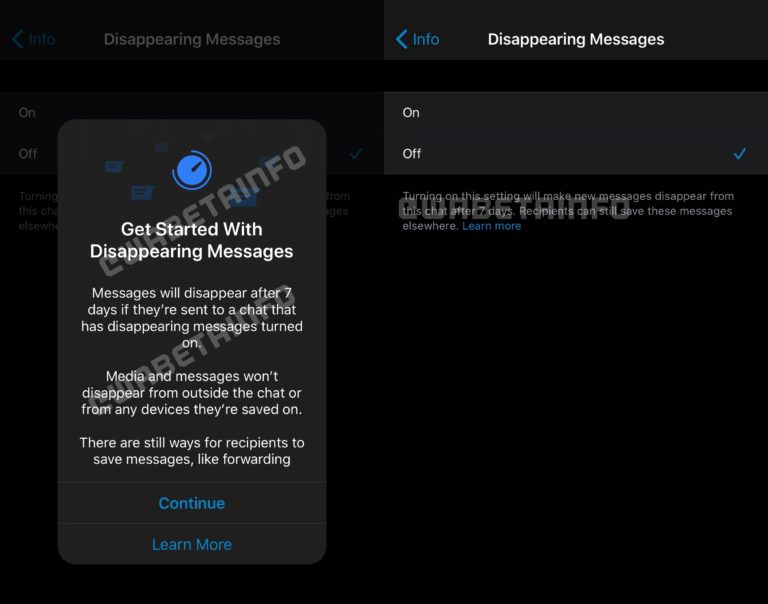
Probably the biggest strike against the WhatsApp feature is that it’s a simple on/off toggle. Meanwhile, both Signal and Telegram feature customizable expiration times that vary from a few seconds to a week. More specifically, WhatsApp’s Disappearing Messages only disappear after seven days. Check out an image obtained by WABetaInfo below.

WABetaInfo WhatsApp Disappearing Messages

Credit:
WABetaInfo

Another noteworthy downside to using this feature is that the recipient’s phone defaults to automatically saving media sent via Disappearing Messages anyway. The FAQ notes that users will need to turn off auto-download functionality (Settings > Data and Storage Usage) to stop this behavior, but presumably this is required for every user in a chat. It makes you wonder what’s the point of Disappearing Messages if they don’t disappear by default.

The FAQ section also cautions that quoting a self-deleting message in a response means that the message “might” remain in a chat after seven days. Furthermore, Disappearing Messages won’t actually delete themselves if they are forwarded to a WhatsApp chat with Disappearing Messages disabled. Both of these behaviors are rather strange, as you’d think even a quoted self-deleting message would be omitted (leaving the reply only) and that forwarding these ephemeral messages wouldn’t be possible.

The team also notes that it’s possible for users to screenshot a self-deleting message, as opposed to offering screenshot alerts as seen in the likes of Snapchat and Telegram. In other words, you’re better off using these two services and Signal if you really want more peace of mind for self-deleting messages.

Next: How to use WhatsApp — A step-by-step guide for beginners


from Android Authority https://ift.tt/3oNvD0q

JBL early Black Friday sale: Save up to 58% on headphones and audio

JBL Flip 5 Promo Shot

Credit:
JBL

We’re starting to see some retailers tease us with a preview of their Black Friday deals, the latest one being the audio giant JBL. From today until Sunday, a handful of the finest JBL products are seeing huge price drops; some as low as 50% off.

Luckily we got wind of these deals early, so you have time to take advantage of your audio accessory of choice before stocks run low. We’ve split the deals into headphone deals and other audio deals below. All of these JBL products come with both free shipping and free 30-day return shipping if you’re not entirely satisfied.

JBL headphones deals

JBL headphones are renowned for their variety, but you’re always guaranteed excellent audio and fine build quality.

There are four pairs of headphones on offer in this Black Friday preview sale. They include the JBL Live 300TWS for $74.95 ($75 off), the Tune 125TWS for $49.95 ($50 off), and the JBL Tune 225TWS for $49.95 ($50 off). You can choose your style of earbuds to suit your tech.

See also: The best headphone deals

Also available are the JBL Endurance Peak headphones for $49.95 ($70 off). The flexible and secure ear hook design keeps them secured while you workout and the IPX7 rating ensures that they’re suitable for all weather conditions.

Check out the offers below.

JBL Live 300TWS Headphones
The JBL Live 300TWS headphones give you up to six hours of playback on a single charge. Pop them into the charging case for up to 14 hours of additional listening, and get up to a one-hour boost in just 10 minutes.
JBL Tune 225TWS Headphones
$49 .95 Save $50 .00
Buy it Now
JBL Tune 125TWS Headphones
$49 .95 Save $50 .00
Buy it Now
JBL Endurance Peak
$49 .95 Save $70 .00
Buy it Now

JBL audio deals

JBL produces everything from speakers to stereo systems, and this variety is reflected in the early Black Friday sale. Both the renowned JBL Flip 5 and the JBL Xtreme 2 are on sale for $69.95 ($50 off) and $149.95 ($200 off) respectively. The Flip 5 features on our best Bluetooth speakers list due to its superb versatility.

Also on offer is the JBL Bar 5.1, which transforms from a soundbar into a true wireless 5.1 home theater system for an epic movie and music-listening experience. It’s down from $499.95 to $299.95 until Sunday.

Check out these deals below, and don’t forget that they’re all subject to stock availability.

JBL Flip 5
$69 .95 Save $50 .00
Buy it Now
JBL Bar 5.1 Surround
$299 .95 Save $200 .00
Buy it Now
JBL Xtreme 2
$149 .95 Save $200 .00
Buy it Now


from Android Authority https://ift.tt/2I72j3W

Oppo is now experimenting with phones that fold in multiple ways

Oppo folding block phones patent

  • Oppo has filed four patents showing phones that can fold in multiple ways.
  • The display of the phones is divided into different folding blocks.

Foldable and flexible displays have certainly brought about a design evolution in the smartphone industry. OEMs are now experimenting with radical designs and recently issued Oppo patents are proof of just how different smartphones could look in the future.

The Chinese phone maker has filed four design patents with the Japan Patent Office (h/t Gizmochina) that show phones that can fold over multiple times. The designs imagine smartphone displays that can fold into various states with the help of a block-like structure.

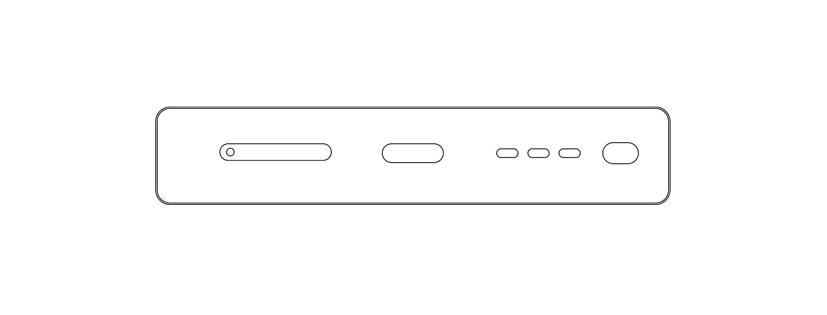
The first patent (pictured below) shows a phone that’s divided into six blocks with a hinge in the center and one above it. It can fold shut like a clamshell or partially close from the top to keep a part of the screen exposed to the user. The cameras are placed on the bottom-most block and remain visible at all times when looking at the screen. The SIM tray, charging port, and speakers are placed below the last block that houses the cameras.

Oppo block phone patent 1 image 2 Oppo block phone patent 1 image 3 Oppo block phone patent 1 image 4 Oppo block phone patent 1 image 6 Oppo Block Phone Patent 1

The second patent application also shows a zigzag foldable phone divided into six blocks. It uses a flexible display and two hinges to fold both inwards and outwards. So in a fully folded state, a part of the display is folded into the body and another part faces outwards. The device can also be partially folded so that one part of the phone acts like a stand. The camera module on this phone is located on the outer side of the first block.

Oppo block phone patent 2 Image 1 Oppo block phone patent 2 image 2 Oppo block phone patent 2 image 3 Oppo block phone patent 2 image 4 Oppo block phone patent 2 image 5 Oppo block phone patent 2

The third patent application shows a taller phone divided into eight blocks instead of six. It can fold inwards into half or partially fold from the top thanks to its two-hinge mechanism.

Oppo block phone patent 3 image 1 Oppo block phone patent 3 image 2 Oppo block phone patent 3 image 3 Oppo block phone patent 3 image 4 Oppo block phone patent 3 image 5

The fourth patent shows a similar phone with an eight-block structure and dual hinges. However, unlike the phone in the third patent, this one sports a camera setup.

Oppo block phone patent 4 image 1 Oppo block phone patent 4 image 2 Oppo block phone patent 4 image 3 Oppo block phone patent 4 image 4 Oppo block phone patent 4

It’s important to note that while these smartphone designs seem pretty out-of-the-box, they are just patents and there’s no guarantee they’ll ever make it to production. That said, we wouldn’t put it past companies to adopt some crazy designs in the future as the popularity of foldable phones grows and they become more accessible to users.

Another challenge with foldable phone designs like these might be durability. We previously saw early foldables having hinge problems, and they only offered one hinge. So manufacturers will have their work cut out for them if they plan to incorporate multiple hinges.

Next: Samsung Galaxy Z Fold 2 review — The only folding phone to buy


from Android Authority https://ift.tt/2JDCklD